What to write in your tennis notes after a match
Start with the mindset, because it changes what you write down. Winning and losing matter less than they feel like they do in the ten minutes after a match. What actually compounds over a season is consistency, passion, and slow improvement. You show up, you work on the serve, the backhand, the drop shot, the slice, bending the knees, keeping your eyes on the ball, and none of it is wasted even on a bad day: it is a full-body workout, a mental workout, and a couple of hours of something you love. Good tennis notescapture that, not just the scoreline.
The best time to write them is the worst time to want to: right after the match, hot, tired, buzzing or fuming. But that is when the details are sharpest. Ten minutes later, driving home, half of it is gone. Here is a short template for tennis match notesthat takes under a minute and is still useful a season from now.

1. The result and score
Match or practice, singles or doubles, set by set, tiebreaks included. Obvious, but it is the spine everything else hangs on. Logged consistently, scores are also what let an app compute your win rate and trend later.
2. The conditions
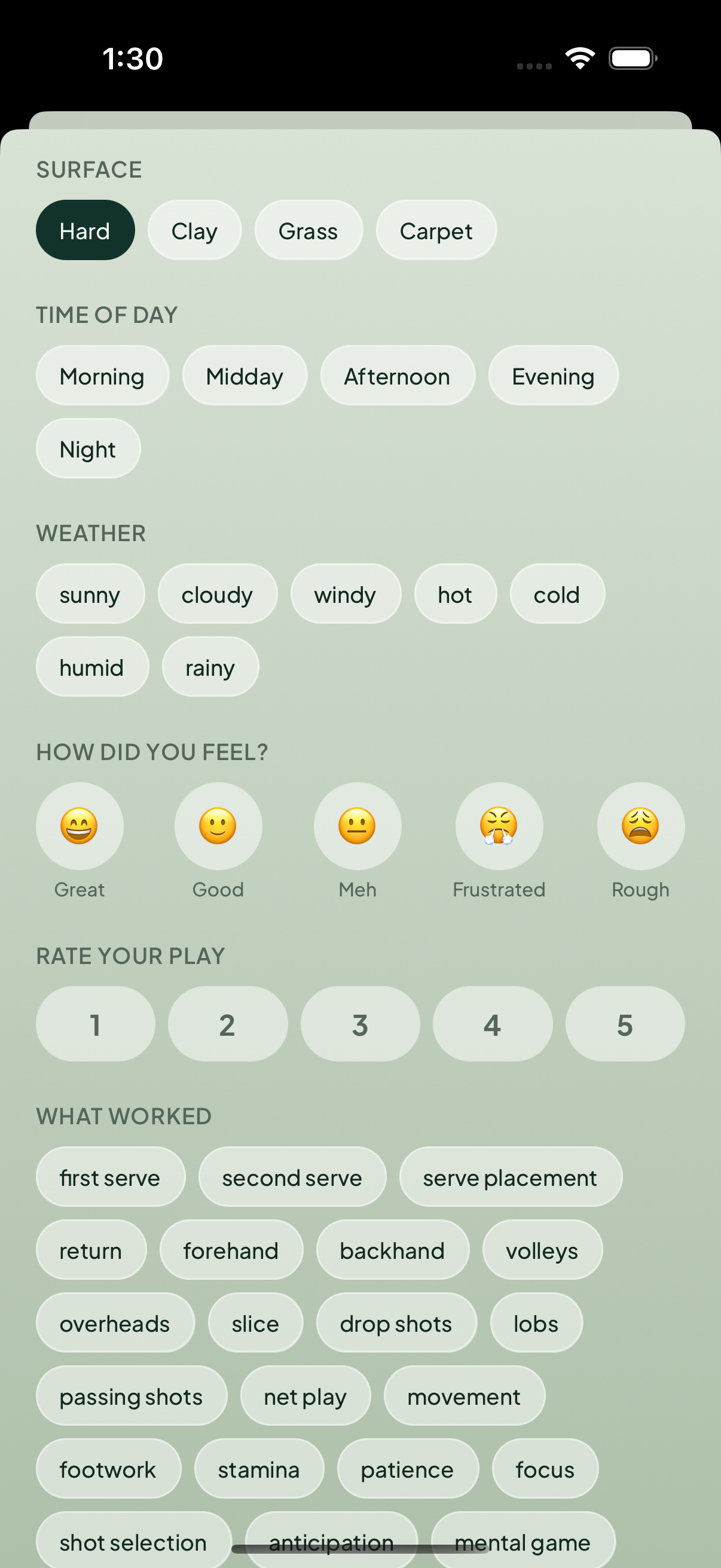
Surface, venue, indoor or outdoor, wind, heat, time of day. Conditions explain an astonishing share of results. The loss that felt like a collapse was maybe just your first match on clay this year. Context now saves you a wrong lesson later.
3. Your mood, before, during, and after
This is the part memory loses first, and the part worth keeping most. Were you nervous on the first serve? Did one bad call tilt you for three games? Did you settle down after a rough start, or spiral? Tennis is a deeply mental game, and your notes are where those patterns become visible.
Frustration after a loss is loud but short. The urge to fix things rarely lasts the week. Writing the feeling down while it stings means the lesson is still there next time, and, just as much, it becomes a record of who you were that season, not only how you played.
4. Your opponent
A couple of lines on how they play (big forehand, weak second serve, hates pace, loves to rally) and a rough game plan for next time. If you play a rotating cast of partners at a club, this is gold. See how to remember opponents for a fuller system.
5. One thing that worked (or didn't)
Not ten things. One. The single takeaway you want to carry into the next session: “serve-and-volley on the deuce side kept winning,” or “stop going for the line down break point.” One clear note you will actually reread beats a paragraph you will not.
6. A photo
The court, the scoreboard, the people you played with. It costs one tap and it anchors the memory better than any stat line. Months later the photo is often what makes you open the entry at all.
Make it a habit, not a chore
The trick is speed. If logging takes five minutes you will stop within a fortnight; if it takes under a minute it sticks. That is why we built tete as a tennis journal with structured fields for all six of these, plus a free-form entry and photos. Tap through it before you have packed your racket, and it quietly compounds into stats, streaks, and a season you can look back on.
Keep at it and the win-loss column stops being the point. You start to see the consistency: weeks played, things practiced, a serve that is steadier than it was in March. That is the real scoreboard, and it is the one worth keeping.