What Is a UTR Rating? Tennis Levels Explained
Tennis players often describe themselves as beginners, intermediates, or advanced players, but those labels can mean very different things. UTR gives players a more consistent numerical scale for describing playing level.
This guide explains what an official UTR Rating measures, what different UTR ranges generally look like, and how to think about your own tennis level.
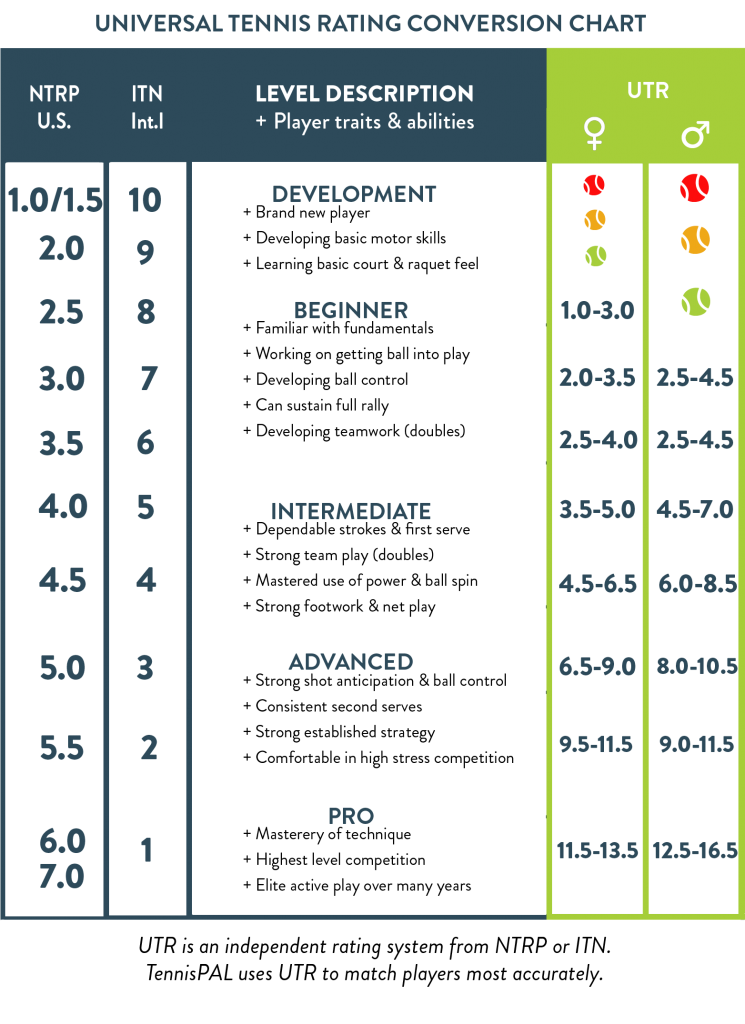
What UTR measures
UTR stands for Universal Tennis Rating. UTR Sports describes it as a rating from 1.00 to 16.50, with players rated on the same scale regardless of age, gender, geography, or skill level. Lifetime Activities summarizes the same point: UTR rates players on one scale “based on actual match results.”
That last phrase matters. An official UTR Rating is not a style score. It is based on competitive match performance, including your opponents' ratings and the percentage of games you win. UTR Sports says the rating is a weighted average of up to 30 recent match ratings, with only matches from the last 12 months counting.
| UTR range | General description |
|---|---|
| 1-2 | New or beginner player |
| 2-4 | Recreational player developing consistency |
| 4-6 | Intermediate club player |
| 6-8 | Strong club or local tournament player |
| 8-10 | Advanced competitive player |
| 10-12 | High-level junior or college-level competitor |
| 12-14 | Elite college, national, or professional-level player |
| 14-16.5 | High-level professional player |
These descriptions are broad guidelines, not official UTR classifications. Two players with similar-looking strokes may have different ratings because match performance also depends on movement, consistency, decisions, fitness, serve and return quality, and pressure.
What levels look like on court
UTR 1-2: beginner
- Still learning basic grips and swing paths.
- Short rallies are possible at a slower pace.
- Serving, scoring, direction, and depth control are still developing.
UTR 2-4: recreational player
- Can rally at a comfortable pace.
- Forehand is usually more dependable than backhand.
- Points are often decided by errors more than deliberate patterns.
UTR 4-6: intermediate club player
- Maintains medium-paced rallies with reasonable consistency.
- Can direct the ball cross-court and down the line.
- Has a recognizable first and second serve and starts building points around strengths.
UTR 6-8: strong competitive club player
- Produces consistent depth with moderate spin or pace.
- Attacks shorter balls intentionally.
- Uses patterns, defends effectively, and transitions between attack and defense.
UTR 8-10: advanced competitor
- Maintains quality under higher pace.
- Uses serve and return to start points with an advantage.
- Changes direction with control and exploits opponents' weaknesses.
UTR 10+
At this level, the difference between strong advanced players and elite players becomes clearer through complete-match performance than isolated strokes. Ball speed, spin, serve and return quality, movement efficiency, tactical adaptability, and competitive consistency all keep rising.
Current top UTR examples
As of 4 August 2026, the top players in published UTR rankings sit at the very top of the scale. The current top ten men are all in the 15.86-16.41 range, while the current top ten women are in the 12.88-13.11 range.
| Rank | Player | Country | UTR |
|---|---|---|---|
| 1 | Jannik Sinner | Italy | 16.41 |
| 2 | Carlos Alcaraz | Spain | 16.32 |
| 3 | Alexander Zverev | Germany | 16.17 |
| 4 | Daniil Medvedev | Russia | 16.08 |
| 5 | Arthur Fils | France | 16.05 |
| 6 | Felix Auger-Aliassime | Canada | 15.92 |
| 7 | Rafael Jodar | Spain | 15.92 |
| 8 | Novak Djokovic | Serbia | 15.90 |
| 9 | Sebastian Korda | USA | 15.87 |
| 10 | Casper Ruud | Norway | 15.86 |
| Rank | Player | Country | UTR |
|---|---|---|---|
| 1 | Aryna Sabalenka | Belarus | 13.11 |
| 2 | Elena Rybakina | Kazakhstan | 13.10 |
| 3 | Marta Kostyuk | Ukraine | 13.08 |
| 4 | Iga Swiatek | Poland | 12.97 |
| 5 | Elina Svitolina | Ukraine | 12.96 |
| 6 | Jessica Pegula | USA | 12.96 |
| 7 | Coco Gauff | USA | 12.93 |
| 8 | Mirra Andreeva | Russia | 12.93 |
| 9 | Victoria Mboko | Canada | 12.89 |
| 10 | Karolina Muchova | Czechia | 12.88 |
How official UTR is calculated
Winning or losing is not the only consideration. UTR compares the percentage of games a player wins with the percentage expected from the ratings of both players. A close 6-4, 6-4 loss against a much stronger opponent can say more about your level than an easy win over a much weaker opponent.
UTR Sports also notes that one match can create a projected rating, and that the rating becomes reliable after roughly five to six matches. The exact effect of any single result still depends on the full rating history and match context.
How to understand your own level
- Play recorded matches against players with known or stable ratings.
- Track results over time instead of judging yourself from one good or bad day.
- Note the context: surface, opponent style, conditions, and how close each set was.
- Look for repeatable patterns in serve, return, rally tolerance, and pressure points.
A single result can be noisy. A journal helps because it keeps the match result beside the details you will otherwise forget: who you played, what worked, and what changed from last time.
Useful sources
- Lifetime Activities: Universal Tennis Rating overview
- UTR Sports: how UTR Rating works
- Sofascore: UTR men rankings
- Sofascore: UTR women rankings
Important: tete is not affiliated with or endorsed by UTR Sports. Official UTR Ratings are calculated from eligible match results.
A number is only half the picture anyway. Your journal holds the part a rating cannot show: who you played, how the match actually went, and what you would do differently.